57m
people living with dementia worldwide
2021 estimate
MemoryHelm helps caregivers turn everyday activities into clear, accessible routines delivered through visual and voice guidance. Every routine requires caregiver review and approval before it becomes active.
NEXT ROUTINE
Take the small watering can.
Fill it halfway with water.
Give each plant a little water.
THE GUIDING PRINCIPLE
AI helps structure, simplify and review each routine. A trusted person decides whether it should become active. Technology provides support, while people retain control.
This short illustrative scenario follows a caregiver using structured visual and voice guidance while retaining responsibility for every decision.
Playing this video connects to YouTube.
Illustrative scenario using synthetic content. Not clinical advice or evidence of effectiveness.
MemoryHelm is designed around a human reality: people may need support with daily routines while still wanting to direct their own day.
people living with dementia worldwide
2021 estimatenew cases every year
Global estimateestimated global cost
2019 estimateof care and supervision each day
Average informal caregiverProjected number of people living with dementia worldwide. These figures describe the context — not an outcome MemoryHelm claims to change.
View sourceA caregiver shares an everyday activity in their own words.
The request becomes a short, predictable sequence of steps.
Potential risks and unclear instructions are surfaced for review.
A trusted caregiver edits, reviews and decides what goes live.
The person sees one calm routine with visual and voice guidance.
Completion, a help request or a call keeps the care loop visible.
“Help Anna water the plants after breakfast. Keep it simple and remind her where the small can is.”
One step at a time, with a voice when you need it.
MemoryHelm can organize support, but it does not quietly take over responsibility. Boundaries are part of the product, not a footnote.
Different agents handle different kinds of work. Their output stays reviewable, bounded and accountable to a human decision.
Coordinates the flow and keeps decisions traceable.
Turns everyday language into structured, practical steps.
Checks for risk, ambiguity and missing human review.
Simplifies language and lowers cognitive load.
Makes requests for help visible to the caregiver.
MemoryHelm began from Ventsislav Asparuhov’s personal experience supporting his late grandmother through dementia.
The original prototype, created under the name MemoryBridge, received Award 1 in the “Agents for Good” category of the Google & Kaggle AI Agents Capstone.
The name changed. The promise stayed: help people preserve moments of independence without asking caregivers to give up visibility or control.
Originally submitted under the name MemoryBridge, the project was selected as the Award 1 winner in the ‘Agents for Good’ category of the Google & Kaggle AI Agents: Intensive Vibe Coding Capstone. The project is now continuing its development under the name MemoryHelm.
The recognition reflected not only the project’s purpose, but also its safety-first architecture and commitment to keeping people in control.
MemoryBridge
now MemoryHelm
MemoryBridge was selected as the Award 1 winner in its category from this global field of projects.
Program statistics reported by GoogleThe next step is not immediate deployment. We are looking to learn from caregivers, dementia professionals and care organizations that can review the workflow and help shape its continued development.
Invited research, healthcare, caregiving, and project collaborators can review MemoryHelm, complete guided evaluations, and keep recommendations documented in one clear workflow.
Open the workspaceAccess is provided directly to approved project collaborators.
Explore the current MemoryHelm workflow in a focused environment.
Document observations, recommendations, and priorities through guided evaluation forms.
Keep feedback, project responses, and subsequent improvements visible in one written process.
MemoryHelm explores responsible research directions in cognitive health and dementia care. These evidence-informed papers identify questions worth investigating without presenting unproven ideas as established treatments.
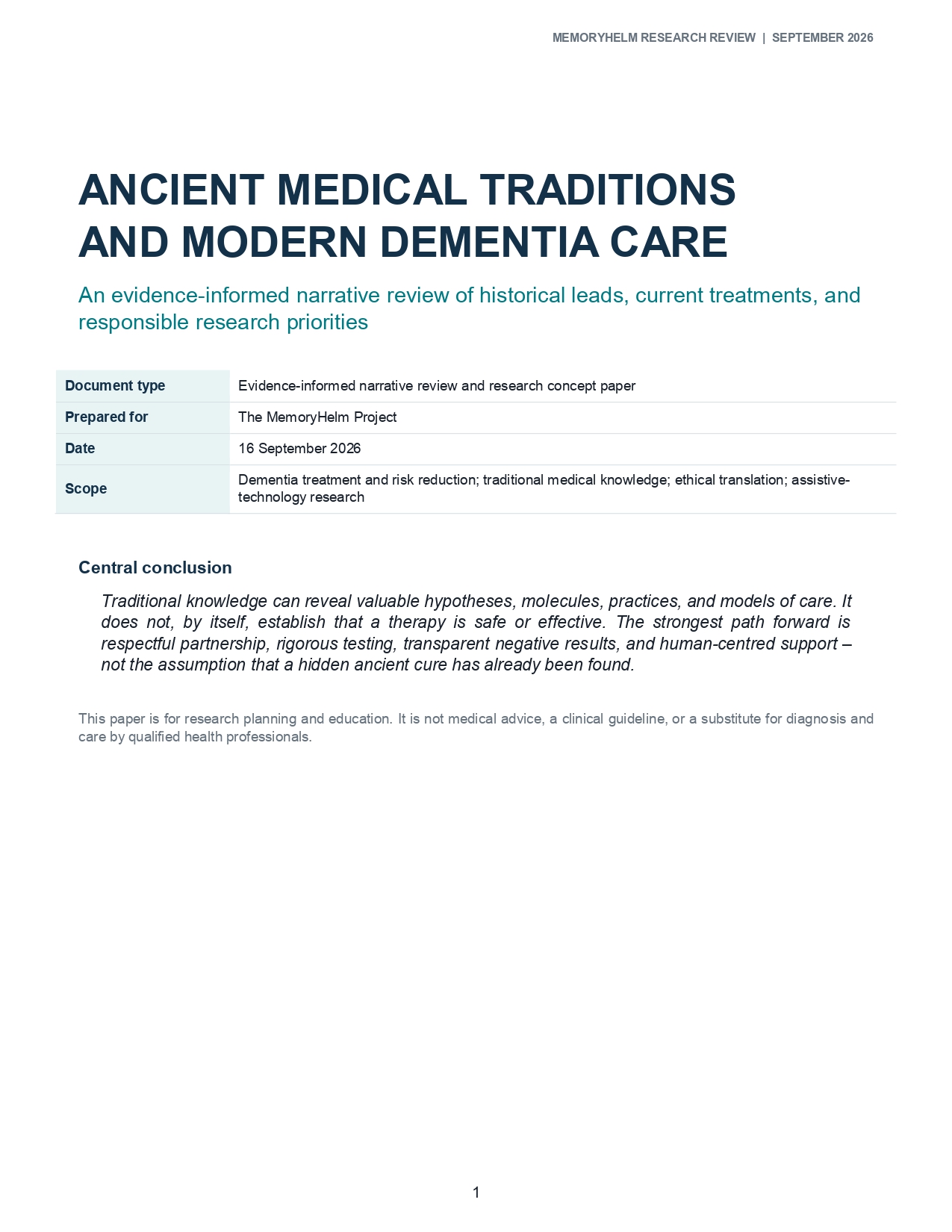
A critical review of historical leads, current treatments, and responsible research priorities – separating potentially testable ideas from unsupported treatment claims.
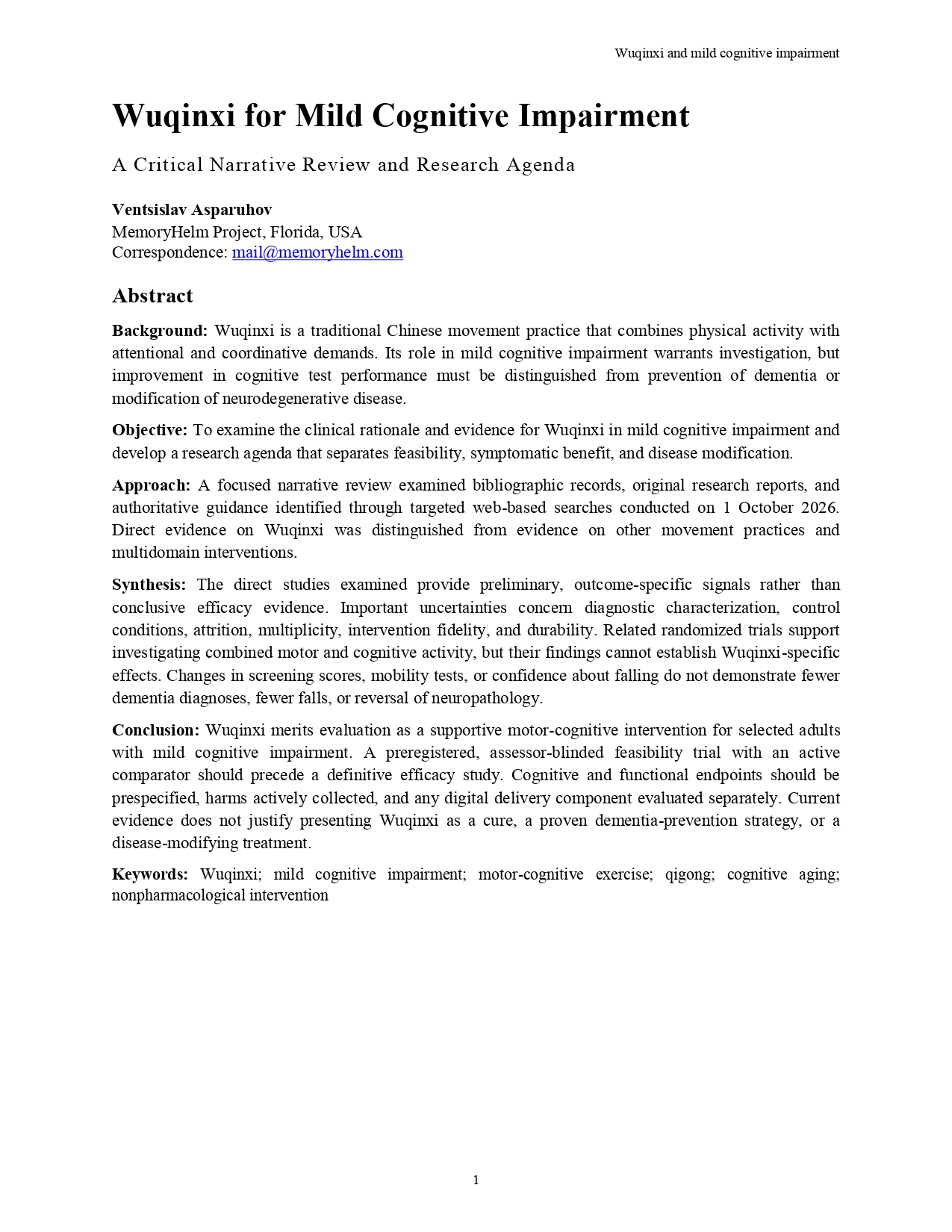
An evidence-focused hypothesis paper examining whether a structured motor-cognitive practice merits careful pilot research in people with mild cognitive impairment.
MemoryHelm research papers are educational and exploratory. They have not been peer reviewed and are not clinical guidelines, medical advice, or substitutes for professional diagnosis or care.
Creator, Project Lead & Lead Developer
Leads MemoryHelm’s product vision, safety-first architecture, AI-agent design, and technical development.
Project Collaborator
Supports MemoryHelm through outreach, partnership development, and connections with research institutions, healthcare organizations, and caregiving communities.